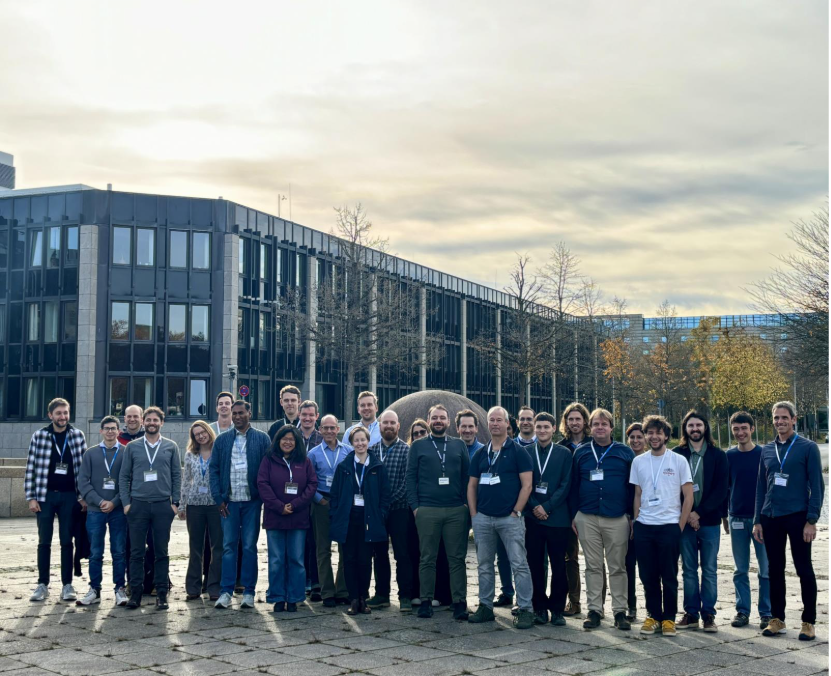
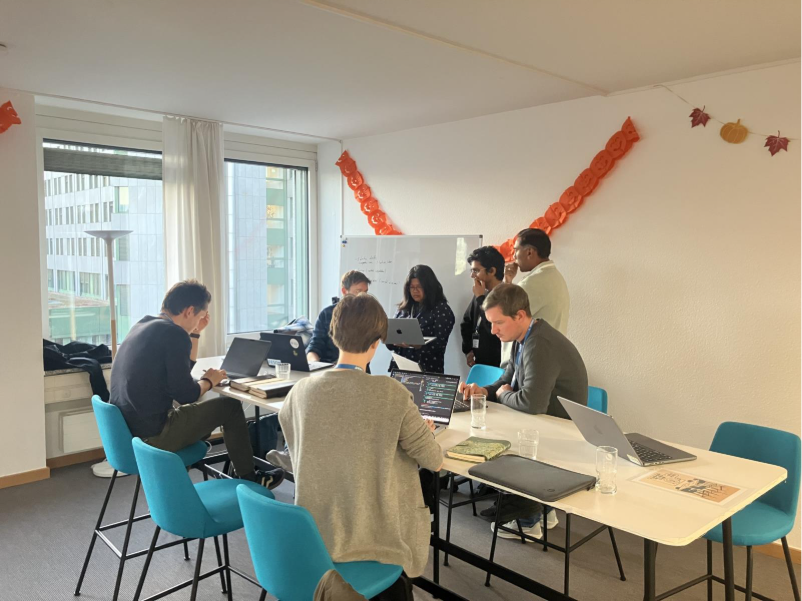
Around 40 partners and ECMWF staff working on the digital twins of the EU initiative Destination Earth (DestinE) gathered for two and a half days to find joint solutions and approaches for delivering impacts with DestinE services effectively. The meeting at ECMWF Bonn’s office created a dynamic exchange where participants were able to better understand digital twin data, and co-design solutions to build Pilot Services and Machine Learning (ML) Demonstrators, while adding value beyond the digital twin data.
Hosts from the ECMWF, Application Partnership Lead Jörn Hoffmann and Digital Technology Lead Nils Wedi, introduced the event and the initial presentations, encouraging participants to exchange, experiment, create examples and spread the word of the powerful applications of DestinE data. Watch: Nils Wedi explaining the aim of the hackathon, highlighting why bringing partners together to explore and test the DestinE data and tools is so important for developing impactful applications.
Director of Destination Earth at ECMWF, Irina Sandu invited participants to demonstrate the added value of the digital twins through concrete examples for various impact sectors sensitive to climate change and extreme events.
The technical & scientific challenges were supported by ECMWF staff members from various teams across the centre, enabling a unique mix of expertise on the digital tools & services such as Polytope, Aviso, Plume, Earthkit, Multio processing chains, as well as on weather and climate data, including the storylines simulations produced by the Climate Change Adaptation Digital Twin (Climate DT). Besides those gathering in Bonn, members from the European Space Agency (ESA) and their partners implementing the DestinE platform were available providing remote support to the participants.
Coding, chatting, showing results and discussing over coffee across the two days helped participants use the DestinE data and tools to advance towards the Pilot Services and ML Demonstrators, focusing on some of the sectors most impacted by climate change and weather extremes.
Voices of the participants: Building solutions together
Participants from ECMWF partners implementing the Climate and regional Extremes, and the pilot Services and Machine Learning Demonstrators attended the hackathon in Bonn. They represented several national meteorological services such as Met Norway, DWD (Germany), DMI (Denmark), FMI (Finland), SMHI (Sweden), KNMI (Netherlands), AWI (Germany), VITO (Belgium), Deltares, Hydrologic (Netherlands) and the Italian supercomputing centre Cineca.
The DestinE Pilot services and ML Demonstrators focus on the use of DestinE digital twin data, in combination with existing data sources, to build applications that respond to specific challenges related to climate change or extreme weather, in sectors such as, transport, agriculture or energy.
Among the participants was Fedde Hop, Data Engineer at the Dutch company Hydrologic, who is working on the Machine Learning Demonstrator for rainfall-induced floods together with partners from Netherland’s KNMU and Weather Impact. Watch the video to find out what this ML Demonstrator is about.
Hop shared that he is particularly excited to showcase how machine learning can help us better adapt to and predict weather extremes.
The power of high-resolution data
High-resolution data and flexible interfaces are essential across all DestinE applications, enabling the different use cases to produce information tailored to the needs of the different sectors they focus on.
Natalia Aleksandrova is an environmental hydrodynamics researcher at Deltares. Together with her colleagues, she is implementing a Pilot Service, which explores how data from the Weather-Induced Extremes Digital Twin (Extremes DT) can help to more accurately predict flooding and storm surges, especially in areas affected by tropical cyclones. Natalia emphasised the advantage of using the high-resolution Extremes DT data, that is needed to better predict storm surges in areas with complex coastlines and topographies. 510 Red Cross is involved in this compound flooding use case.
Full Stack Data Scientist Warre Verlinde from PropheSea works on the Pilot Service for Dynamic Line Rating, a method for better exploiting available capacity in energy grids. Accurate weather predictions are key to supporting confident estimates of future grid capacity. Verlinde describes this as follows:
Similarly, Armelle Remedio, Climate Scientist at the Alfred-Wegener-Institute, Helmholtz Centre for Polar and Marine Research (AWI), highlighted the benefits of using high-resolution data from Climate DT.
Collaboration at the core
Participants agreed that it was highly valuable to meet in person and to be able to exchange face to face on the best solutions to build the applications making use of DestinE data and services. Special online sessions with Gaia Cipolletta from Serco, ESA’s contractor responsible for the onboarding process to the DestinE platform, also helped to better understand how to integrate the pilot services.
The hackathon clearly demonstrated how collaboration drives innovation within the European Commission’s DestinE initiative. Natalia Aleksandrova pointed out what makes the collaboration within DestinE so special.
At the end of the two days, participants had moved forward in their objectives. Some had refined and advanced their ongoing work through the discussions and the hands-on sessions. All the partners found it very useful to spend some time together to drill down on specific issues, far from the daily routine work and with plenty of direct exchanges to create innovative solutions and build bridges between partners and across different projects.
Destination Earth is a European Union funded initiative launched in 2022, with the aim to build a digital replica of the Earth system by 2030. The initiative is being jointly implemented by three entrusted entities: the European Centre for Medium-Range Weather Forecasts (ECMWF) responsible for the creation of the first two ‘digital twins’ and the ‘Digital Twin Engine’, the European Space Agency (ESA) responsible for building the ‘Core Service Platform’, and the European Organisation for the Exploitation of Meteorological Satellites (EUMETSAT), responsible for the creation of the ‘Data Lake’.
We acknowledge the EuroHPC Joint Undertaking for awarding this project strategic access to the EuroHPC supercomputers LUMI, hosted by CSC (Finland) and the LUMI consortium, Marenostrum5, hosted by BSC (Spain) Leonardo, hosted by Cineca (Italy) and MeluXina, hosted by LuxProvide (Luxembourg) through a EuroHPC Special Access call.
More information about Destination Earth is on the Destination Earth website and the EU Commission website.
For more information about ECMWF’s role visit ecmwf.int/DestinE
For any questions related to the role of ECMWF in Destination Earth, please use the following email links: