Climate Change Adaptation Digital Twin
What is the Climate DT?
| The Destination Earth Climate Change Adaptation Digital Twin (Climate DT) sets up an operational simulation framework providing globally consistent high-resolution climate and impact-sector information, at spatial scales where many of the impacts of climate change and extreme events are observed. It allows to both simulate possible future evolutions of the climate system on multi-decadal timescales and assess “what-if” scenarios, supporting climate adaptation efforts across Europe. The Climate DT is implemented by a partnership led by CSC – IT Center for Science in close collaboration with ECMWF, reflecting a broad European collaboration across operational prediction centres, supercomputing centres and academia. |
Global overlay of different variables from the three Climate DT model systems: ICON (left), IFS-FESOM (center) and IFS-NEMO (right). The example snapshots show information from the atmosphere (clouds in white, precipitation rate in colours), and from the coupled ocean (temperature in color, current speed via differences in brightness). Credit: ECMWF / Andreas Müller
Access the latest Climate DT simulations and services
A new set of simulations is now available, building on upgraded climate models and impact-sector applications. Explore the data, interactive visualisations and much more.
Key capabilities
- Kilometre-scale resolution: Enables realistic representation of local climate conditions and extreme events, globally.
- Multi-decadal climate simulations: global multi-decadal simulations describing the climate evolution under a specific future scenario for the period 1990-2049
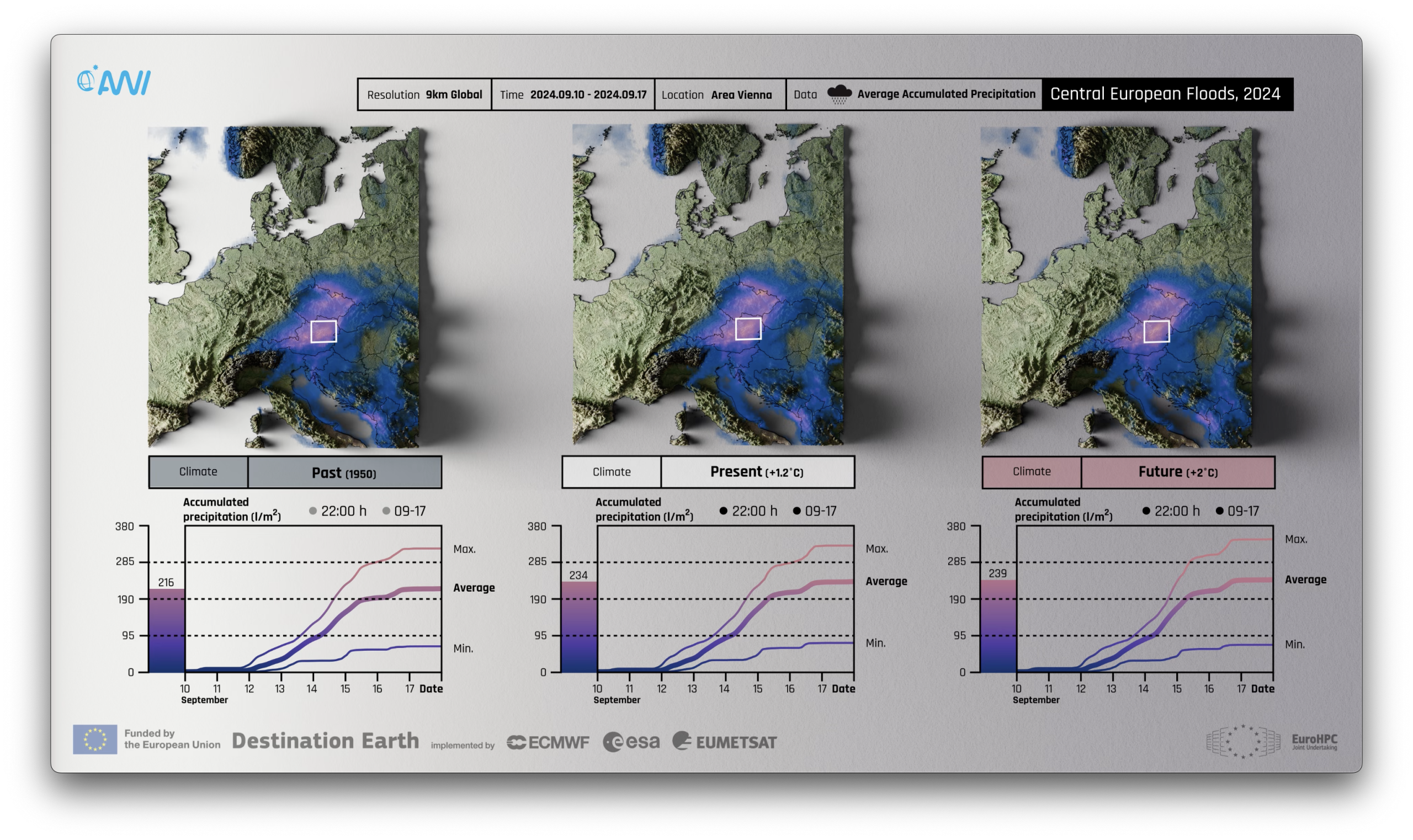
- Storyline simulations: Allow replaying events, that occurred worldwide, under past, present, and warmer climates to assess changing impacts.
- Sector-specific applications: Translate climate information into actionable indicators for climate sensitive-sectors such as, energy, hydrology, and wildfire risk.
- Operational, quality-controlled workflow: enable routine, reliable execution of simulations, data handling and evaluation, with consistent, validated outputs.
Storyline simulation From Past to Future – The Central European Floods, 2024 in a Changing Climate.” The panels compare accumulated precipitation near Vienna under past (1950), present, and future (+2°C) climate conditions. These visualisations are allowed by the simulations produced with the Climate DT. Credit: AWI Climate DT team.
The Climate DT relies on three Climate models – ICON, IFS-FESOM, and IFS-NEMO. New simulations now provide a consistent dataset covering the period from 1990 to 2049, at resolutions of approximately 5km for the atmosphere and land surface and between 5 and 10 km for the ocean and sea-ice, and with hourly temporal resolutions. A set of impact-sector applications are fully integrated into the Climate DT workflow, allowing to translate climate data into indicators for areas such as onshore and offshore wind energy, wildfires, hydrology, and extreme precipitation as the climate simulations run.