
Machine Learning Demonstrator – Energy Systems
Supporting decision-making in grid planning.
Main contractor: German Aerospace Center (DLR), Institute of Networked Energy Systems
What is it? European Transmission System Operators (TSOs) must plan and manage the European extra-high-voltage electricity grid, ensuring the infrastructure can meet the demands.
With the share of renewable energy sources increasing, meteorological simulations become an increasingly important information for grid management. At the same time, climate information is becoming more and more important for planning and adequacy assessments. DLR’s Institute of Networked Energy Systems and its partners (Aarhus University and Renewables Grid Initiative (RGI) are using data from the Climate Change Adaptation Digital Twin (Climate DT) and state-of-the art energy grid models to train and validate an advanced machine learning (ML) system to help optimising the power flow across the European electricity grid.
Concrete applications examples:
The Demonstrator shows how TSOs could receive enhanced information supporting decision-making in grid planning and adequacy assessments and contributing to managing uncertainties in renewable energy generation and improving grid stability.
Main target end users:
Electricity grid operators
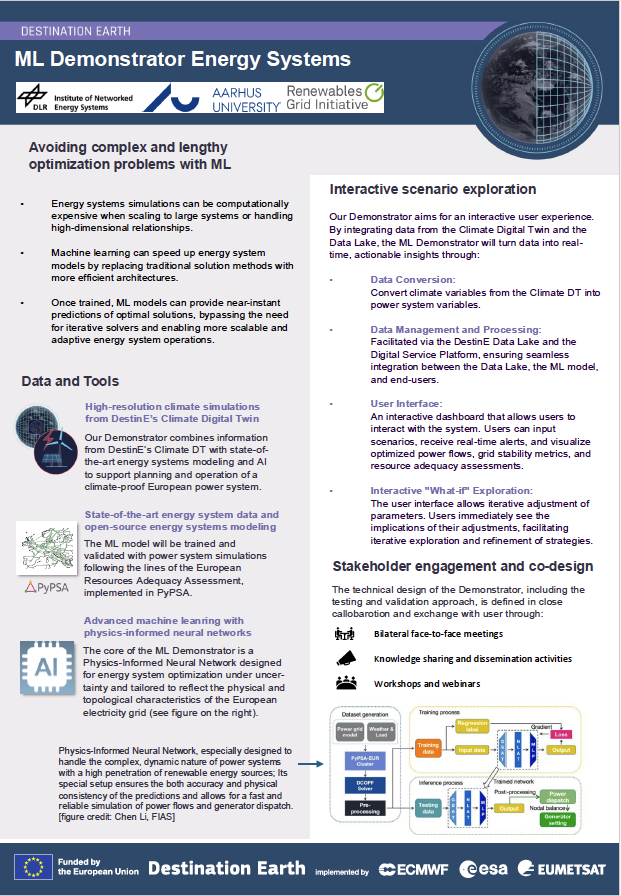
Factsheet: Click the graphic below to view the full PDF factsheet on the Machine Learning Demonstrator for Energy Systems.
Climate DT data to improve energy grid stability
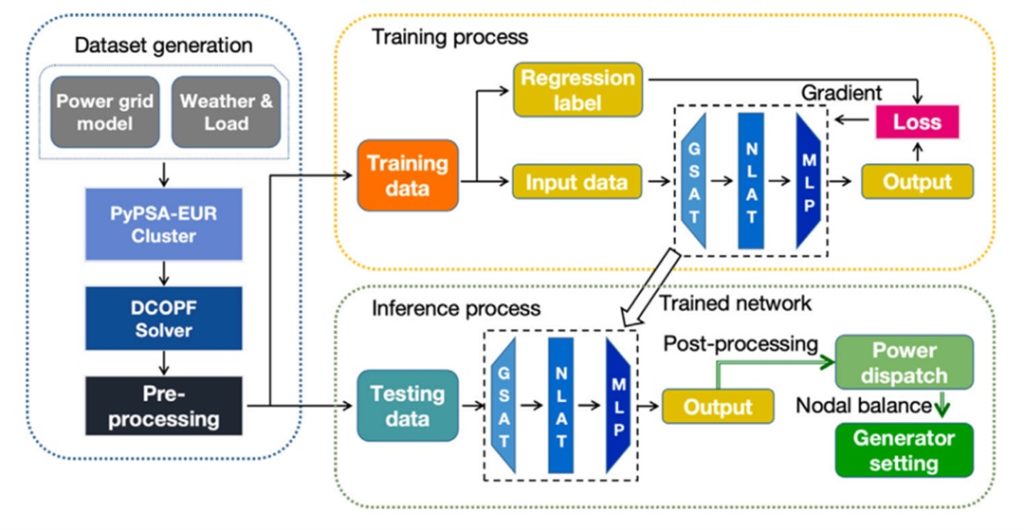
DLR is partnering with Aarhus University and Renewables Grid Initiative (RGI) to implement an innovative ML demonstrator based on a sophisticated Physics-Informed Neural Network designed to handle the complex and dynamic nature of power systems, in particular energy grids with a high contribution of renewable energy resources. The system benefits from the work already achieved in the Energy Systems use case of DestinE.
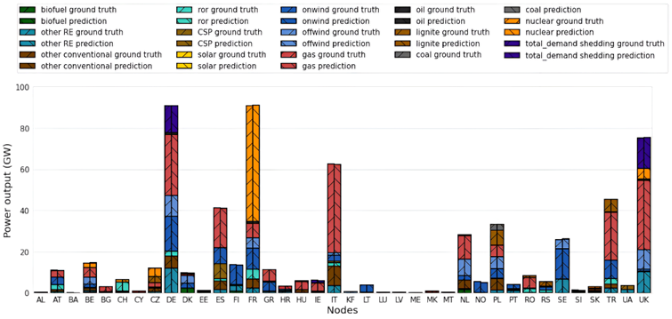
The system is trained with high-resolution meteorological data from DestinE’s Climate Digital Twin and other sources, generating relevant power-system input data such as expected energy demand and potential generation from renewables, combined with a state-of-the-art power system model. The trained ML Demonstrator aims at providing prediction for the cost-optimal generator dispatch and power flow. The system is designed to scale with the size of the grid and the complexity of the power system. Therefore, it is suitable for both local and continental-scale energy systems.
By combining data-driven approaches with physics-based principles the neural network demonstrator provides robust and physically consistent results, compared to purely data-driven models. Thanks to its sophisticated physics-informed Neural Network model the demonstrator provides fast optimal or near-optimal solutions to improve the power flow efficiency at relatively low computing costs. The technology also allows users to test scenarios based on different inputs.
The developments of the Machine Learning demonstrator Energy Systems can therefore support the operational needs of TSOs in grid operation, resource adequacy assessments, and investment planning. Due to its high efficiency, it can support interactive explorations of “what-if” questions like the effect of different extreme weather episodes (e.g., Dunkelflaute) on the energy system, or the consequences of different scenarios on renewables production and/or consumption patterns under climate change.
The demonstrator builds on existing energy modelling tools and services such as those offered by Copernicus and national grid operators, but introduces advanced machine learning techniques and the Climate DT data to provide faster, scalable and more adaptative solutions for grid operators.
As DestinE’s ML Demonstrator Energy Systems aims to play a pioneering role in supporting complex and impactful decision-making processes in energy system planning, a key element for the successful endorsement of the Demonstrator’s capabilities is ensuring users’ trust in the machine learning applications. To build trust in the approach used for the Demonstrator, implementation and validation are conceptualized in exchange with users. The validation of the Demonstrator will include reliability indicators, sensitivity analysis and estimated uncertainties, identifying distinct critical cases of limited model performance. Visualisation tools and a graphical user interface will lower entry-barriers and allow users to make concrete experiences with the developed ML approach.
Machine Learning (ML) Demonstrator contracts aim at showing the added value of the DestinE Digital Twins, ML tools and the wider DestinE System. The contracts include specific actions for machine learning and artificial intelligence-based solutions as part of the implementation of ML/AI techniques within the Destination Earth initiative of the European Commission, led by DG CNECT, and implemented by ECMWF, EUMETSAT, ESA and over 100 partner institutions across Europe.
Copyright title image: AdobeStock – Jason Bennee