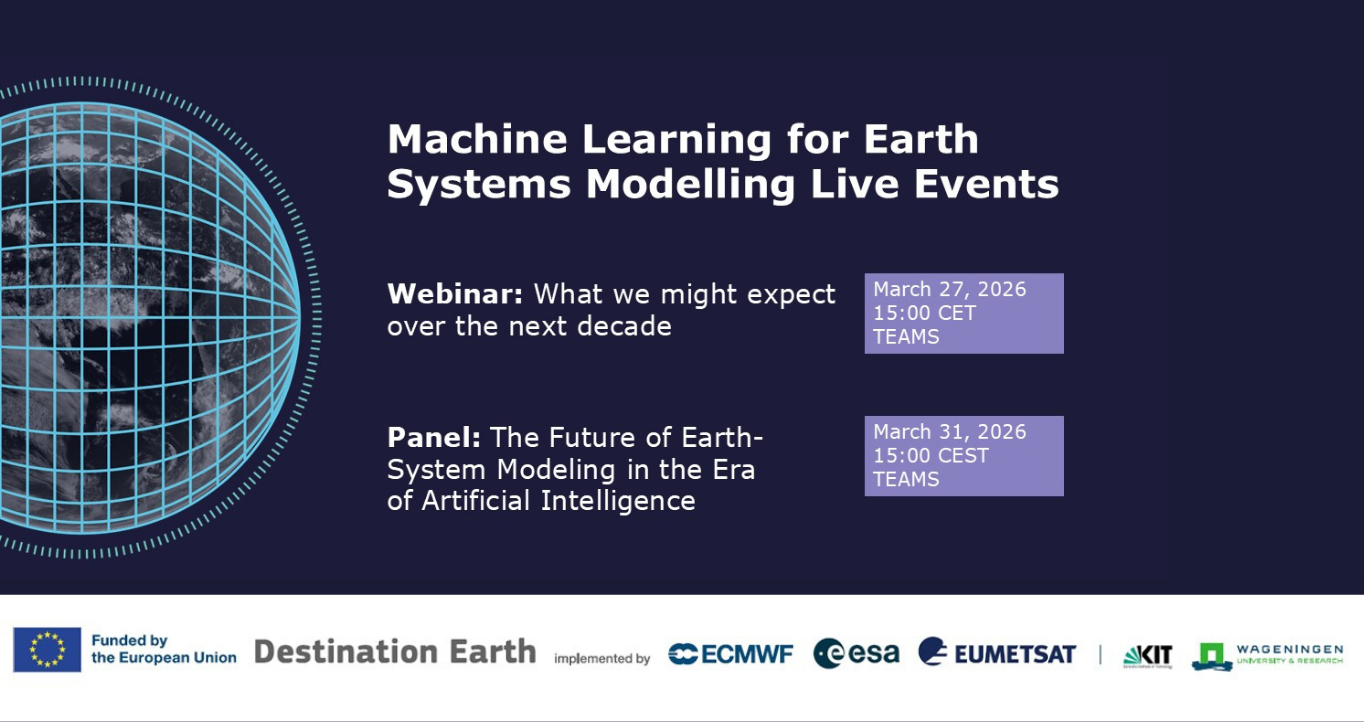
ECMWF will host two live online events on 27 and 31 March 2026, under the Destination Earth (DestinE) initiative of the European Commission, to discuss the evolving role of machine learning (ML) and artificial intelligence (AI) in Earth system modelling.
Bringing together leading experts from research institutions, operational centres, and the private technology sector, these events will offer diverse perspectives on how ML and AI are transforming the way we understand and simulate the Earth system.
Both sessions are open to the public and are especially relevant for participants of the course ‘Machine Learning for Earth Systems Modelling: Foundations and New Frontiers’.
Webinar: Machine learning for Earth system modelling – what we might expect over the next decade
Date: 27 March 2026
Time: 15:00 CET
Duration: 1 hour
This webinar examines how machine learning is expected to shape weather and climate modelling over the next decade. Experts will share their perspectives on developments in AI forecasting systems, hybrid modelling approaches and emerging integrated approaches such as foundation models and jointly coupled AI-driven Earth system models, followed by a moderated discussion and audience Q&A.
Confirmed speakers include Peter Dueben (ECMWF), Sara Hahner (ECMWF), Tom Beucler (University of Lausanne), Peter Knippertz (Karlsruher Institut für Technologie – KIT), and Fernando Iglesias-Suárez (Predictia). The webinar will be hosted by Dwaipayan Chatterjee (Karlsruher Institut für Technologie – KIT).
Panel discussion: The future of Earth system modelling
Date: 31 March 2026
Time: 15:00 CEST
Duration: 1 hour
The panel will address topics including increasing model resolution and complexity, coupling across Earth system components, evaluation and trust in AI-driven systems, and the relationship between forecasting skill and scientific understanding. The session will be moderated by Dwaipayan Chatterjee (Karlsruher Institut für Technologie – KIT) and will conclude with a live moderated Q&A based on questions submitted by participants.
Confirmed panellists are Rachel Furner (ECMWF), Martin Schultz (Forschungszentrum Jülich), Phillip Stier (University of Oxford), and Sophie Buurman (Royal Netherlands Meteorological Institute – KNMI).
Who is it for?
The two live events target a broad audience of high-level information users and policy and decision-makers from European public and private sectors, academia, and industry who are interested in the broader implications of machine learning for Earth systems modelling.
The events are part of a course series on ML learning, developed by ECMWF in collaboration with Karlsruhe Institute of Technology (KIT), Wageningen University & Research and supported by a network of European scientists.
Registration
Participation is free of charge. The event is open to the public and to learners of the course ‘Machine Learning for Earth Systems Modelling: Foundations and New Frontiers’. Please note that course participants are still required to register separately to attend the live sessions.
Register now for the webinar ‘Machine learning for Earth system modelling – what we might expect over the next decade‘.
Register now for the panel discussion ‘The future of Earth system modelling‘.
Discover our ML training page with more information.
Destination Earth is a European Union funded initiative launched in 2022, with the aim to build a digital replica of the Earth system by 2030. The initiative is being jointly implemented by three entrusted entities: the European Centre for Medium-Range Weather Forecasts (ECMWF) responsible for the creation of the first two ‘digital twins’ and the ‘Digital Twin Engine’, the European Space Agency (ESA) responsible for building the ‘Core Service Platform’, and the European Organisation for the Exploitation of Meteorological Satellites (EUMETSAT), responsible for the creation of the ‘Data Lake’.
We acknowledge the EuroHPC Joint Undertaking for awarding this project strategic access to the EuroHPC supercomputers LUMI, hosted by CSC (Finland) and the LUMI consortium, Marenostrum5, hosted by BSC (Spain) Leonardo, hosted by Cineca (Italy) and MeluXina, hosted by LuxProvide (Luxembourg) through a EuroHPC Special Access call.
More information about Destination Earth is on the Destination Earth website and the EU Commission website.
For more information about ECMWF’s role visit ecmwf.int/DestinE
For any questions related to the role of ECMWF in Destination Earth, please use the following email links: