Destination Earth (DestinE) is entering its operationalisation phase, bringing together expertise in Earth system modelling, software engineering, high-performance computing and artificial intelligence. To provide a clear and structured overview of this complex ecosystem, this three-episode animated series invites viewers to follow main character Rosa in her adventures as she explores some of DestinE’s core components. Along the way, she explains how artificial intelligence can enhance simulations, how the Climate Change Adaptation Digital Twin (Climate DT) supports decision-making, and how the Digital Twin Engine underpins the Digital Twins operations.
Episode 1: Artificial intelligence and forecast uncertainty
The first episode focuses on the scientific foundations of prediction and the role of artificial intelligence within DestinE. Rosa begins by explaining how ensemble forecasts, such as those run operationally at ECMWF, help quantify forecast uncertainty. Understanding uncertainty is essential for interpreting model outputs and making informed decisions.
Building on this foundation, the episode shows how AI and machine learning developments are being integrated into DestinE’s Digital Twins. These approaches enhance the representation and quantification of uncertainty in high-resolution simulations, contributing to improved efficiency and scientific robustness.
Episode 2: The Climate Change Adaptation Digital Twin
In this episode, Rosa explores how the Climate DT can support adaptations efforts by harnessing high-resolution climate models, next-generation supercomputers, innovative digital technologies and flexible workflows. It helps understand how the Climate DT can be applied in real-world scenarios, from helping cities mitigate the Urban Heat Island effect to preparing for extreme flooding. With the ability to simulate future climate conditions and “what-if” scenarios at an unprecedented scale, it offers a powerful tool for building resilience and safeguarding communities.
Episode 3: The Digital Twin Engine
When Rosa meets a solar energy manager in search of precise, tailored data, she discovers how the Digital Twin Engine serves as a key component of DestinE, operating at multiple levels within this complex system.
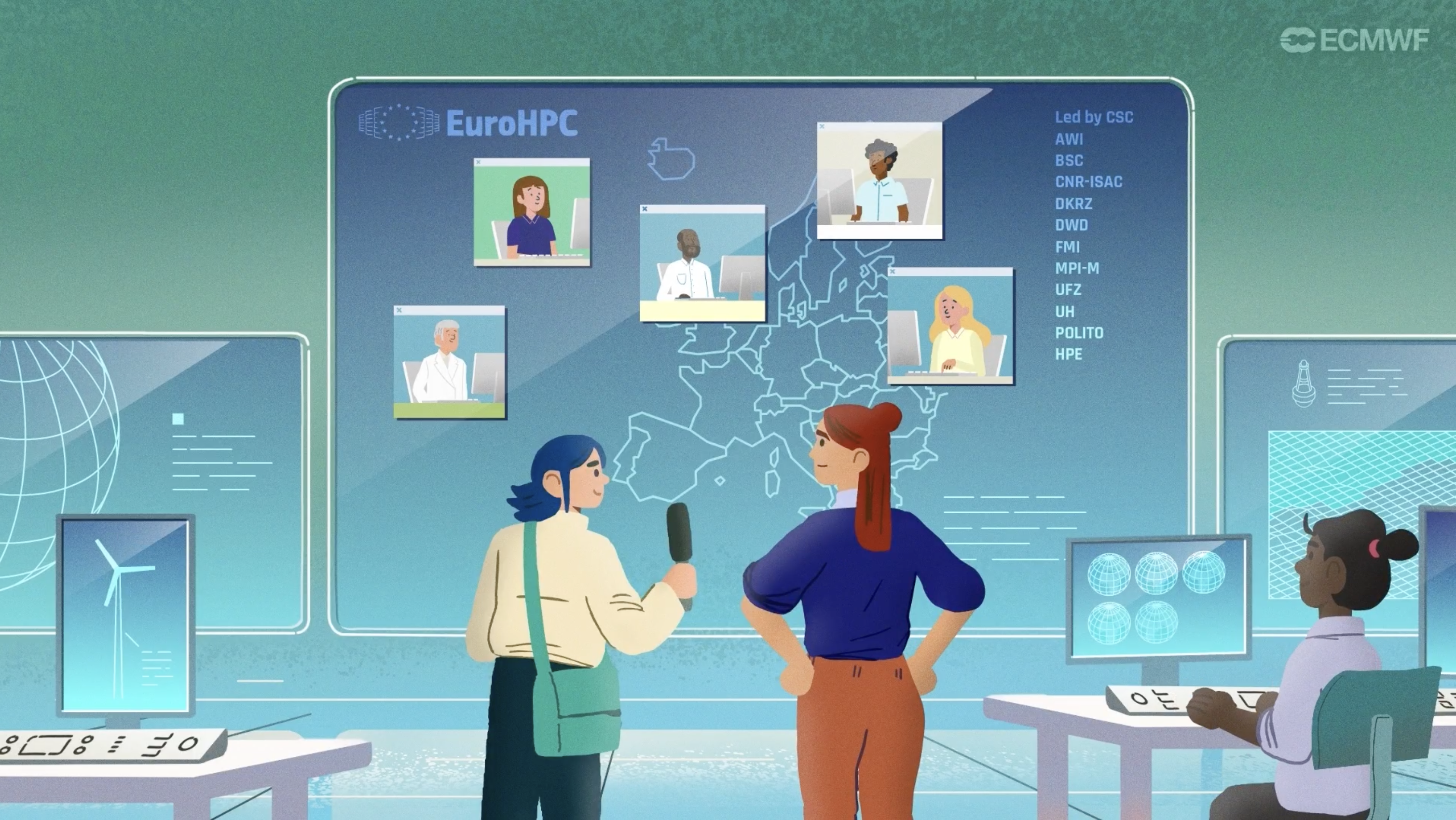
From orchestrating a unified simulation workflow across various EuroHPC supercomputers to enabling efficient AI training, the Digital Twin Engine proves essential to DestinE’s operations. Rosa also learns how it helps users extract exactly the data they need from the vast outputs generated by digital twins.
Discover more DestinE animations, simulations and videos on our multimedia page.
Destination Earth is a European Union funded initiative launched in 2022, with the aim to build a digital replica of the Earth system by 2030. The initiative is being jointly implemented by three entrusted entities: the European Centre for Medium-Range Weather Forecasts (ECMWF) responsible for the creation of the first two ‘digital twins’ and the ‘Digital Twin Engine’, the European Space Agency (ESA) responsible for building the ‘Core Service Platform’, and the European Organisation for the Exploitation of Meteorological Satellites (EUMETSAT), responsible for the creation of the ‘Data Lake’.
We acknowledge the EuroHPC Joint Undertaking for awarding this project strategic access to the EuroHPC supercomputers LUMI, hosted by CSC (Finland) and the LUMI consortium, Marenostrum5, hosted by BSC (Spain) Leonardo, hosted by Cineca (Italy) and MeluXina, hosted by LuxProvide (Luxembourg) through a EuroHPC Special Access call.
More information about Destination Earth is on the Destination Earth website and the EU Commission website.
For more information about ECMWF’s role visit ecmwf.int/DestinE
For any questions related to the role of ECMWF in Destination Earth, please use the following email links: