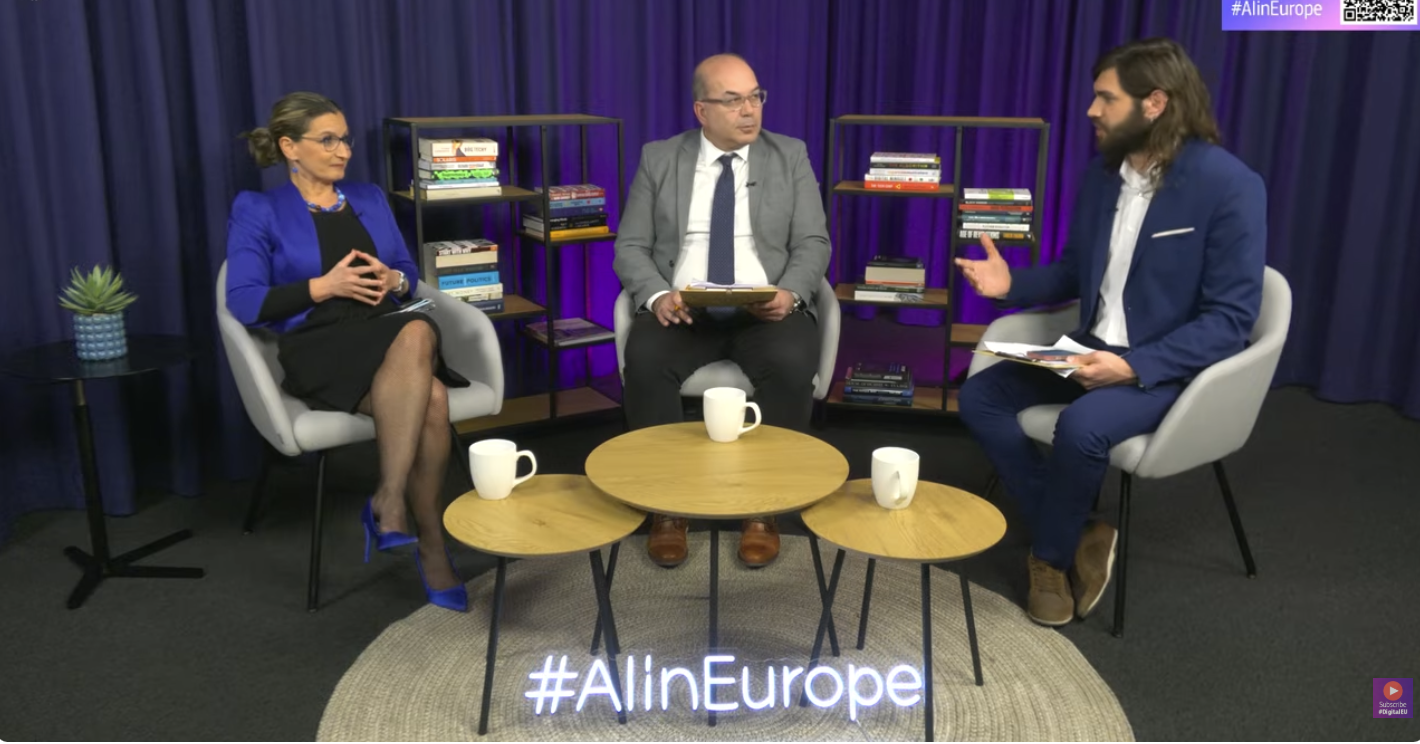
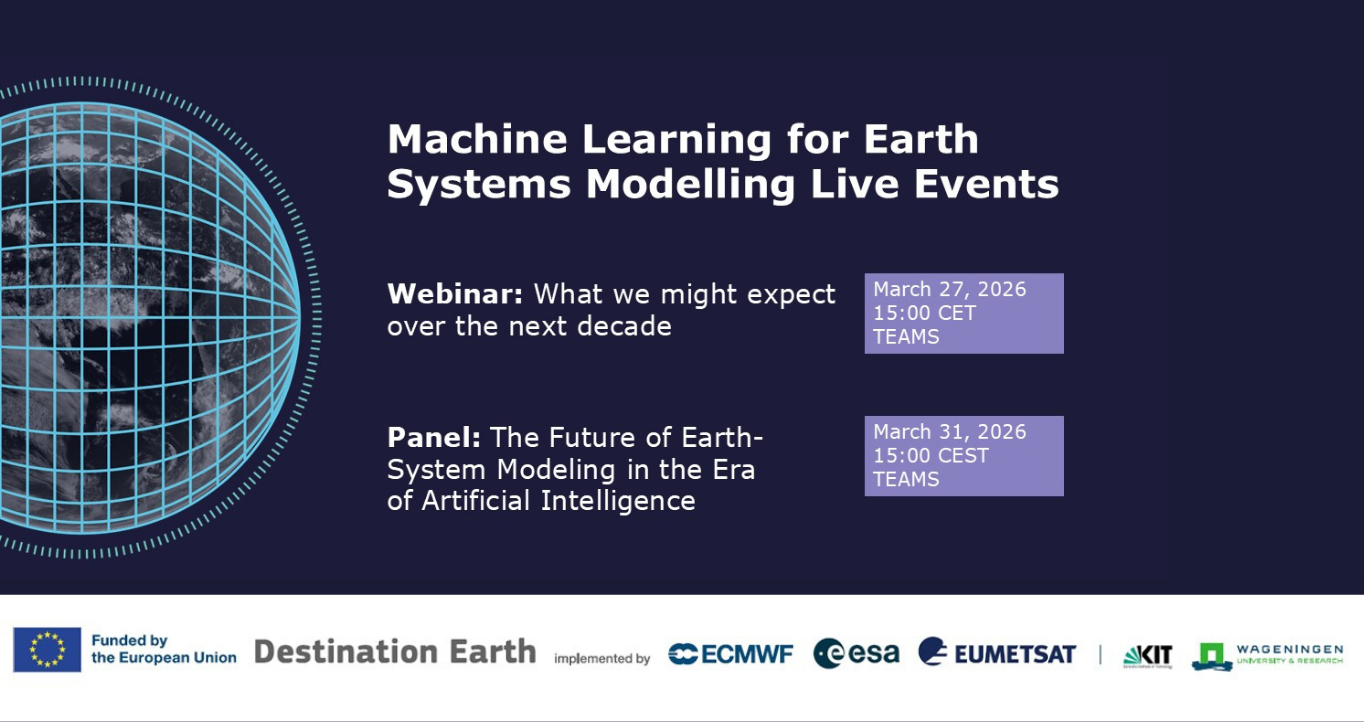
From 23 to 27 February 2026, the European Centre for Medium-Range Weather Forecasts (ECMWF) hosted a five-day training course in Bonn dedicated to machine learning (ML) in the framework of the Destination Earth (DestinE) initiative of the European Commission. The course brought together scientists and software engineers from meteorology, climate science, Earth system modelling and ML from across Europe and beyond, to exoplore how Artificial Intelligence (AI) is transforming numerical weather prediction and Earth system science.
Within DestinE, artificial intelligence and machine learning are playing an increasingly central role. These techniques support innovative modelling approaches that complement the physics-based digital twins and contribute towards the development of an AI Earth system model.
The five-day training course introduced experts in meteorology and climate science to the concepts and methods of machine learning, drawing on Earth system modelling examples from DestinE as well as on ECMWF’s Artificial Intelligence integrated Forecasting System (AIFS) and the Anemoi software framework, developed in close partnership with national meteorological services.
A course tailored to Earth system sciences and machine learning
The week opened with welcome remarks by William Becker, Training Specialist in machine learning at ECMWF and main organiser of the event, followed by an overview and motivation session by ECMWF Scientist Christian Lessig that set the scientific and strategic context for machine learning within DestinE.
Watch: William Becker explaining the aim of the training course.
ECMWF scientists guided participants through the foundations of machine learning before moving to the deep learning approaches that underpin cutting edge ML modelling, including graph neural networks, convolutional neural networks and transformers.
The programme also addressed deep generative models for ensemble forecasting, along with practical aspects such as model evaluation, training datasets and preparing models for operational use. Throughout the week, lectures and discussions were complemented by hands-on coding sessions using the European Weather Cloud.
From research to operations: data-driven forecasting in practice
A central focus of the training course was how machine learning methods are being increasingly used both for research and for operational forecasting. In a session on data-driven weather prediction, ECMWF Scientist Mariana Clare introduced the scientific foundations of AIFS and explained how it complements ECMWF’s physics-based forecasting portfolio.
Participants then explored these concepts in practice, running components of AIFS during hands-on sessions supported by ECMWF Scientists Jakob Schlör, Mariana Clare and Mario Santa Cruz Lopez. This provided first-hand insight into how data-driven models are trained, evaluated and prepared for operational use.


Participants collaborating during hands-on machine learning coding sessions.
The course also featured dedicated sessions and practical exercises on Anemoi, a collaborative open-source software framework developed by ECMWF together with several national meteorological services across Europe.
Anemoi provides a highly flexible framework for building, training and operationalising data-driven forecasting models for weather and other Earth system components. It underpins ECMWF’s operational AIFS model, the Earth system ML components developed in DestinE, as well as other European systems, like AICON developed by Deutscher Wetterdienst (DWD) and Bris developed by the Norwegian Meteorological Institute (Met Norway).
Watch: Joffrey Dumont Le Brazidec, ECMWF Scientist, explaining the use of Anemoi within DestinE.
Through hands-on work with datasets, model configurations and training strategies, participants learned how Anemoi enables organisations to develop and run ML forecasting systems using their own data while benefiting from shared tools and community expertise.
Another highlight of the course was the Forecast-in-a-Box concept, introduced by Harrison Cook, Research Software Engineer at ECMWF.
In his presentation, he illustrated how data driven weather models built with, Anemoi and related tools can be combined into modular, ready-to-use forecasting workflows. By packaging open-source software and AI models from ECMWF and Member States into reproducible pipelines covering data input, simulation, post-processing and visualisation, Forecast-in-a-Box enables users to run and adapt AI simulations even with limited computational resources.
Extending machine learning across the Earth system
Participants also learned about the development of AI-based models of Earth system components within DestinE, including land, hydrology, ocean and sea ice.
Rachel Furner, ECMWF Scientist, presented the progress towards building an AI-based Earth system model within DestinE.
Watch: Rachel Furner explaining how DestinE is building an AI-based Earth system model.
ECMWF Scientis Maria Luisa Taccari presented ECMWF’s global deep learning model “AI for Flood Forecasting” (AIFL) model as an example of how deep learning can extend predictive capabilities in hydrology.
AIFL addresses flooding hazards through a global deep learning approach. The model is fine-tuned with forecasts from ECMWF’s Integrated Forecasting System, IFS, and delivers fast, scalable predictions with lead times of up to ten days, supporting flood preparedness and early warning.
This example illustrates how ML-based Earth system components, developed in the framework of DestinE, can enhance prediction capabilities beyond the atmosphere and contribute to improved Earth system predictions.
Watch: Maria Luisa Taccari summarising the advantages of using ML for Earth systems modelling.
Strengthening Europe’s expertise in machine learning for weather and climate prediction
By combining theoretical foundations, practical coding sessions and operational examples, the course demonstrated how machine learning is revolutionising weather and climate predictions. It also showed how data-driven methods are emerging as powerful complementary tools within the Destination Earth ecosystem.
The training provided participants with both practical skills and strategic insight into the future of AI-enhanced Earth system modelling and prepared them to bring machine learning innovation into their daily practice and contribute to the evolving landscape of weather and climate prediction.
Watch: Hear what participants are taking away from the training.
Through training initiatives such as this, ECMWF and Destination Earth continue to strengthen expertise across Europe and support the development of the next generation of climate and weather prediction capabilities.
ECMWF is launching a series of ML online training courses. Find more information here.
Destination Earth is a European Union funded initiative launched in 2022, with the aim to build a digital replica of the Earth system by 2030. The initiative is being jointly implemented by three entrusted entities: the European Centre for Medium-Range Weather Forecasts (ECMWF) responsible for the creation of the first two ‘digital twins’ and the ‘Digital Twin Engine’, the European Space Agency (ESA) responsible for building the ‘Core Service Platform’, and the European Organisation for the Exploitation of Meteorological Satellites (EUMETSAT), responsible for the creation of the ‘Data Lake’.
We acknowledge the EuroHPC Joint Undertaking for awarding this project strategic access to the EuroHPC supercomputers LUMI, hosted by CSC (Finland) and the LUMI consortium, Marenostrum5, hosted by BSC (Spain) Leonardo, hosted by Cineca (Italy) and MeluXina, hosted by LuxProvide (Luxembourg) through a EuroHPC Special Access call.
More information about Destination Earth is on the Destination Earth website and the EU Commission website.
For more information about ECMWF’s role visit ecmwf.int/DestinE
For any questions related to the role of ECMWF in Destination Earth, please use the following email links: