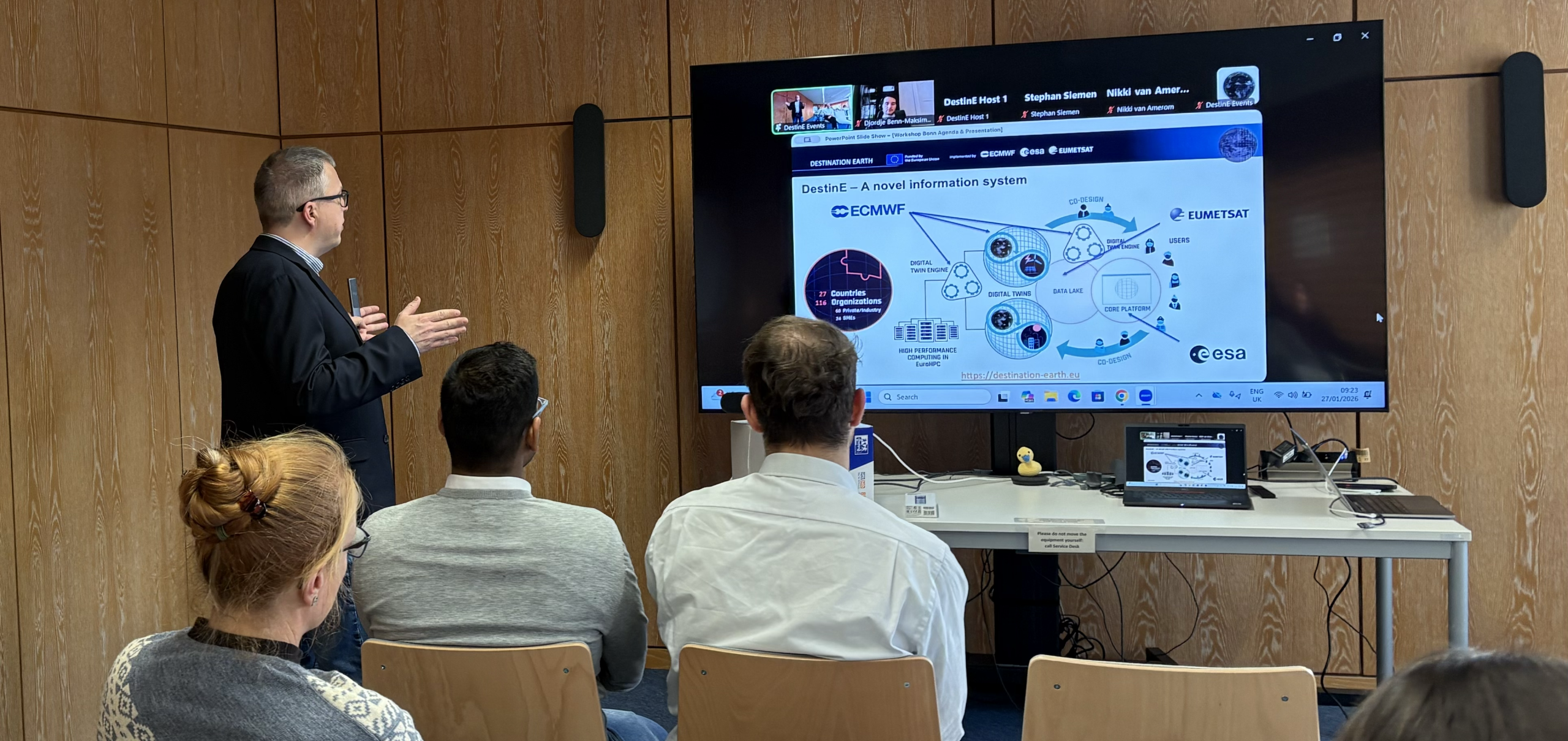
“How can artificial intelligence ethically be used in weather and climate forecasting?” That question brought together experts from national meteorological and hydrological services, government agencies, academia, and industry across Europe for a virtual workshop hosted by the European Centre for Medium-Range Weather Forecasts (ECMWF) on 27 January 2026. Hosted from ECMWF’s Bonn office, Exploring an Ethics Framework for AI in Weather and Climate Predictions, formed part of the European Commission’s Destination Earth (DestinE) initiative.
The webinar focused on exploring a possible ethics framework to guide the rapid uptake of AI in operational prediction systems. The discussion centred on practical, shared principles for trustworthy AI in weather and climate services. Participants agreed that AI is transforming forecasting and requires clear, common governance.
From internal groundwork to community dialogue
Building on an internal discussion and exchanges on experiences within Destination Earth this event broadened the discussion to the wider European community.
Ethics integrated into daily practice
Nikki van Amerom (Atos) welcomed the participants, introducing the seminar and the agenda. Stephan Siemen (ECMWF) then set the scene by outlining the challenges but also warned, not to be too restrictive. “It is important to find practical guidelines and raise awareness with developers and users of AI systems. Ethics guidelines should not be seen as an additional hurdle but integrate – and become business-as-usual – as cybersecurity and GDPR guidelines have before.” The discussion also considered on how to align new tools with European values, existing regulation such as the EU AI Act, and the long-standing culture of scientific transparency in weather and climate services.
The core outcome: Whitepapers and practical guidelines
Central to the programme were a set of whitepapers and developer guidelines prepared under a DestinE contract with Atos Germany and the Fraunhofer IAIS, which review various ethical aspects of data-driven forecasting.
Introducing the opening whitepaper, Djordje Benn-Maksimovic (Atos) highlighted multiple ethical considerations and societal implications that arise from the rapid uptake of ML-based forecasts and how these differ from traditional NWP systems. He pointed out ways in which ECMWF and other institutions are already addressing these concerns by their longstanding tradition of transparency and collaboration.
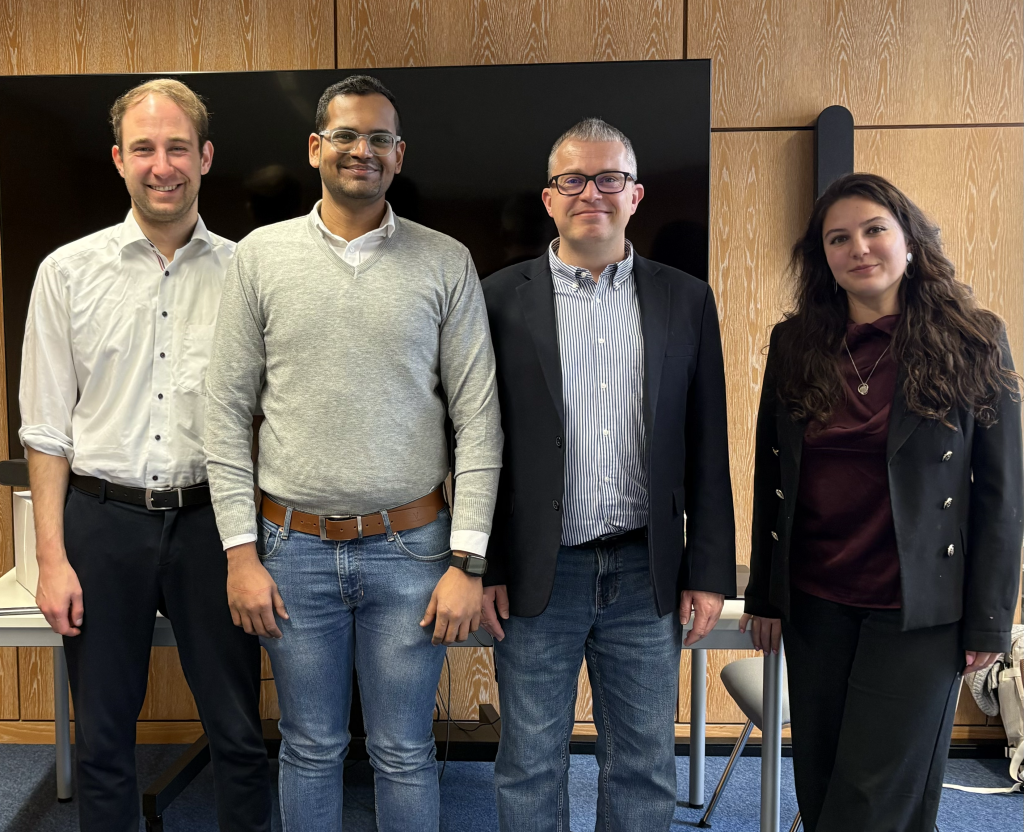
On the more technical side, Sebastian Schmidt (Fraunhofer IAIS) followed with a discussion of robustness and reproducibility challenges along the AI lifecycle and Ranjith Mahendran (Atos) covered ways to enhance the explainability of ML models and to increase their resilience against data manipulations.
Alongside these, Sebastian Schmidt gave an overview of a first draft of practical guidance for developers, including checklists intended to help teams implement ethical principles in real-world projects rather than leaving them at the level of theoretical aspirations.
“Taking a structured approach to ethical AI supports developers in keeping an overview of important ethical topics to look out for in daily business. By adapting the structure of the Fraunhofer IAIS AI Assessment Catalog while focusing on the most focal points, the document remains concise, while offering a structured view.”, noted Sebastian Schmidt.
Community perspective
Adding a strong community perspective, Marek Jacob from DWD presented the work of the EUMETNET E-AI Ethics working group, part of a wider European AI programme that coordinates collaboration across national meteorological services. He outlined how the group is building networks of experts and is preparing a common framework to address ethical challenges in the reliable deployment and use of AI. He told participants that “By working together across Europe, we can develop a harmonised and actionable framework to evaluate and compare our AI developments on ethical measures.”
What’s next
The workshop is closely linked to the broader DestinE vision of building high-resolution digital twins of the Earth system by 2030, which will support climate adaptation, disaster risk management and long-term policy planning. As AI models become central components of these digital twins, speakers stressed that ethical guardrails and AI literacy are essential to ensure that powerful new tools remain transparent, robust and aligned with the public good.
Organisers indicated that feedback from this event will feed into the refinement of the whitepapers and developer guidance, which will contribute of the work of the Ethics working group of the EUMETNET-AI project. The work will also feed into future training on the use of AI at ECMWF.
Read the documentation
Adoption of Ethical Principles for Machine Learning in the Meteorological Domain
Explainability and Adversarial Vulnerability in AI-Based Weather Forecasting Systems
Robustness and reproducibility for data-driven weather forecasting
Practical Guidelines on Ethical Machine Learning
Watch the recording of the webinar:
Destination Earth is a European Union funded initiative launched in 2022, with the aim to build a digital replica of the Earth system by 2030. The initiative is being jointly implemented by three entrusted entities: the European Centre for Medium-Range Weather Forecasts (ECMWF) responsible for the creation of the first two ‘digital twins’ and the ‘Digital Twin Engine’, the European Space Agency (ESA) responsible for building the ‘Core Service Platform’, and the European Organisation for the Exploitation of Meteorological Satellites (EUMETSAT), responsible for the creation of the ‘Data Lake’.
We acknowledge the EuroHPC Joint Undertaking for awarding this project strategic access to the EuroHPC supercomputers LUMI, hosted by CSC (Finland) and the LUMI consortium, Marenostrum5, hosted by BSC (Spain) Leonardo, hosted by Cineca (Italy) and MeluXina, hosted by LuxProvide (Luxembourg) through a EuroHPC Special Access call.
More information about Destination Earth is on the Destination Earth website and the EU Commission website.
For more information about ECMWF’s role visit ecmwf.int/DestinE
For any questions related to the role of ECMWF in Destination Earth, please use the following email links: