Developing machine learning (ML)-based Earth system model components is central to the AI activities implemented by ECMWF and their partners within the Destination Earth (DestinE) initiative of the European Commission. This blog series shares insights from experts building these components, highlighting their approaches and contributions towards a coupled ML-based Earth system model.
A machine-learned sea ice model for predictions

By Lorenzo Zampieri, Scientist, ECMWF
Together with Sara Hahner, Rachel Furner, Sarah Keeley and Matthew Chantry
Sea ice is a cornerstone of the Earth system. It regulates heat exchange between the ocean and atmosphere, shapes polar ecosystems, and plays a critical role in global climate variability. At the same time, it is one of the most rapidly changing components of the climate system. Accelerated warming in polar regions has led to shrinking ice extent, thinning ice cover, and increasing interannual variability — all of which make sea ice prediction more challenging and more important than ever.
Within the Destination Earth (DestinE) initiative, machine learning (ML) offers a powerful new approach to modelling sea ice. By learning directly from decades of high-quality reanalysis data, ML models can emulate complex sea ice evolution with high accuracy and at a fraction of the computational cost of traditional numerical models. In this blog, we introduce the DestinE prototype ML sea ice component and highlight its performance in predicting events.
Building a data-driven sea ice model
We developed the DestinE ML sea ice prototype as a global stand-alone system, designed to evolve sea ice and surface-ocean conditions forward in time when forced by atmospheric predictions. The model operates at a horizontal resolution of approximately 0.25°, comparable to ECMWF’s state-of-the-art physical sea ice system, and produces output every 6 hours. Training is based on 30 years (1993–2022) of data from the ORAS6 ocean and sea ice reanalysis, with atmospheric forcing from ERA 5 implemented by the Copernicus Climate Change Service (C3S). During inference, the model is driven by forecasts from ECMWF’s Artificial Intelligence Forecasting System (AIFS), allowing it to generate fully independent sea ice predictions beyond the training period. Data from 2023 onwards is reserved exclusively for out-of-sample evaluation.
What does the model predict?
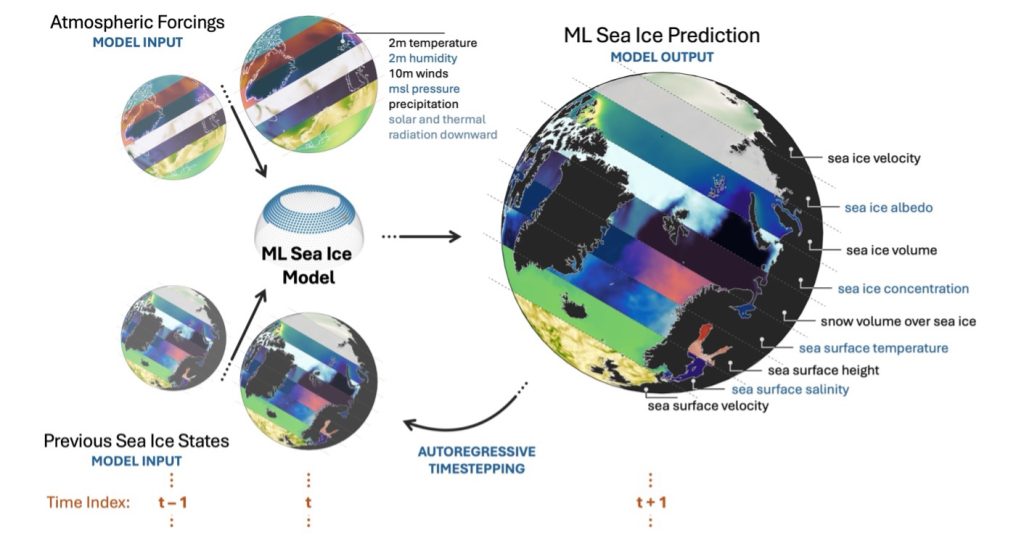
The ML sea ice model predicts a comprehensive set of variables describing both sea ice state and its oceanic context (Figure 1). Sea ice outputs include:
- Sea ice concentration
- Sea ice volume per unit area
- Snow volume over sea ice per unit area
- Sea ice albedo
- Sea ice velocity
To provide physical context and improve predictive skill, the model simultaneously simulates key surface-ocean variables, including temperature, sea-surface height, salinity, and velocity. Learning these variables together enables the model to capture the tight coupling between ocean and ice that governs ice evolution.
The model architecture closely follows the sliding-window transformer design used in AIFS, in which predictions are advanced step by step in time, and is implemented within the Anemoi ecosystem developed by ECMWF and several national meteorological services across Europe. Several targeted strategies ensure physically consistent behaviour. All variables are constrained to remain within their physically meaningful ranges, and sea ice concentration is treated as a core sea ice variable that conditions the evolution of other ice and ocean variables. In practice, this ensures that ice properties are only predicted where ice is present, mirroring established practices in physics-based sea ice modelling (Figure 2).
How well does it perform?
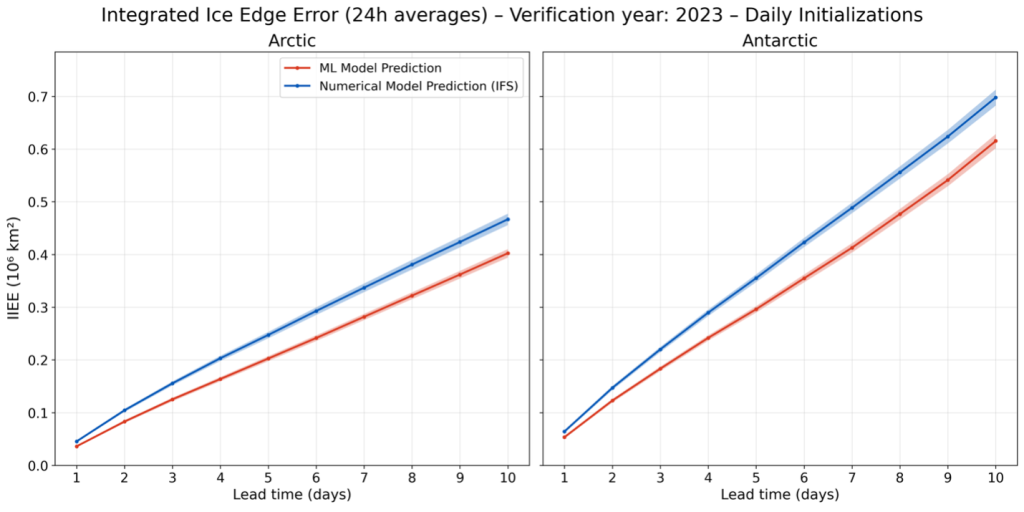
A key measure of sea ice prediction quality is the accuracy of the predicted ice edge, identified as the boundary where sea ice concentration rises above 15%. This threshold is widely used because it marks conditions that are critical for polar operations, shipping, and ecosystem monitoring. To assess this, we evaluate the ML prototype using the Integrated Ice Edge Error (IIEE) and compare it against ECMWF’s forthcoming state-of-the-art numerical coupled prediction system (Figure 3).
Across a full year of daily predictions in 2023, the ML model systematically outperforms the numerical system at all lead times, in both the Arctic and Antarctic. The improvement grows with prediction range, reaching approximately 15–20 % of the total error by day 10. In terms of effective skill, this corresponds to a gain of around 1.5 prediction days, consistent with results seen in atmospheric ML models.
Case study: Winter 2023 in the European Arctic
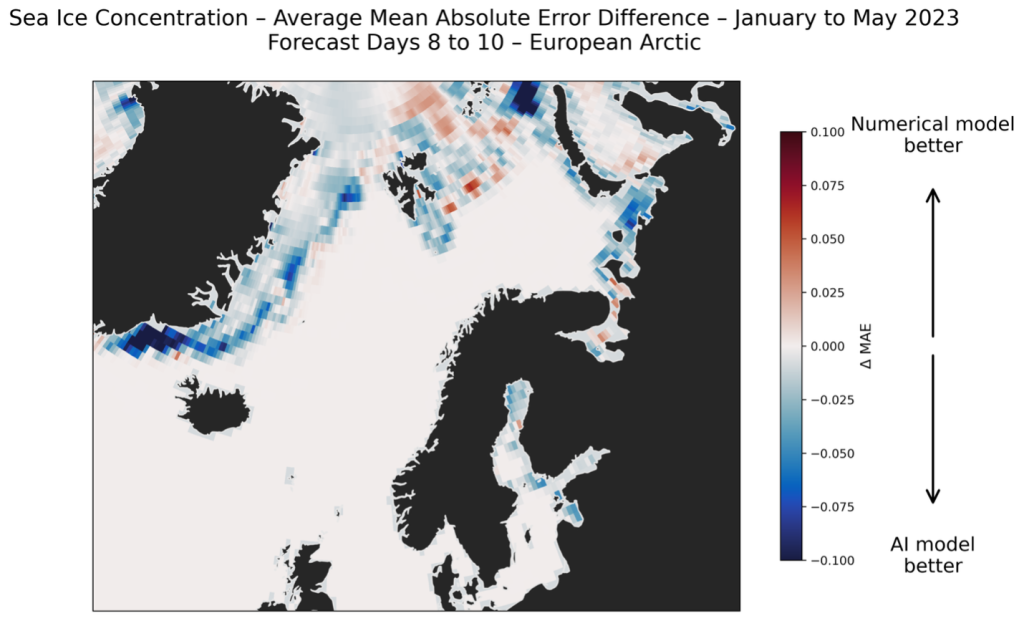
To complement global statistics, we examine the ML sea ice prototype during the 2023 freezing season (January–May) in the European Arctic. This regional analysis confirms the hemispheric results: the ML model outperforms the physics-based system across most of the domain, with robust gains along the ice edge and in the Baltic Sea (Figure 4).
Although sea ice appears in the Baltic for only part of the year, its presence has major implications for navigation, regional weather, and marine operations. Accurately capturing its onset and retreat is therefore of high practical value. The ML model shows clear advantages in this region, demonstrating its ability to learn both large-scale sea ice behaviour and finer regional characteristics.
Looking ahead
The results obtained so far demonstrate that machine learning can emulate sea ice with high fidelity, capturing both typical seasonal evolution and challenging ice-edge behaviour. Our ongoing work focuses on extending the evaluation to longer timescales, particularly the subseasonal-to-seasonal (S2S) range, where sea ice is a well-known source of environmental predictability.
In the future, we will also explore the benefits of coupling the ML sea ice model with other ML Earth-system components, including waves, ocean, and atmosphere. By integrating these components within a unified framework, Destination Earth aims to unlock new capabilities for fast, accurate, and physically consistent Earth-system prediction.
The ML sea ice prototype represents an important step toward this vision — complementing physics-based models and helping pave the way toward a fully data-driven Earth-system model.
Image credit title image: Alfred-Wegener-Institute / Mario Hoppmann
Destination Earth is a European Union funded initiative launched in 2022, with the aim to build a digital replica of the Earth system by 2030. The initiative is being jointly implemented by three entrusted entities: the European Centre for Medium-Range Weather Forecasts (ECMWF) responsible for the creation of the first two ‘digital twins’ and the ‘Digital Twin Engine’, the European Space Agency (ESA) responsible for building the ‘Core Service Platform’, and the European Organisation for the Exploitation of Meteorological Satellites (EUMETSAT), responsible for the creation of the ‘Data Lake’.
We acknowledge the EuroHPC Joint Undertaking for awarding this project strategic access to the EuroHPC supercomputers LUMI, hosted by CSC (Finland) and the LUMI consortium, Marenostrum5, hosted by BSC (Spain) Leonardo, hosted by Cineca (Italy) and MeluXina, hosted by LuxProvide (Luxembourg) through a EuroHPC Special Access call.
More information about Destination Earth is on the Destination Earth website and the EU Commission website.
For more information about ECMWF’s role visit ecmwf.int/DestinE
For any questions related to the role of ECMWF in Destination Earth, please use the following email links: