
ML Earth System Components
Machine Learning Earth System Components
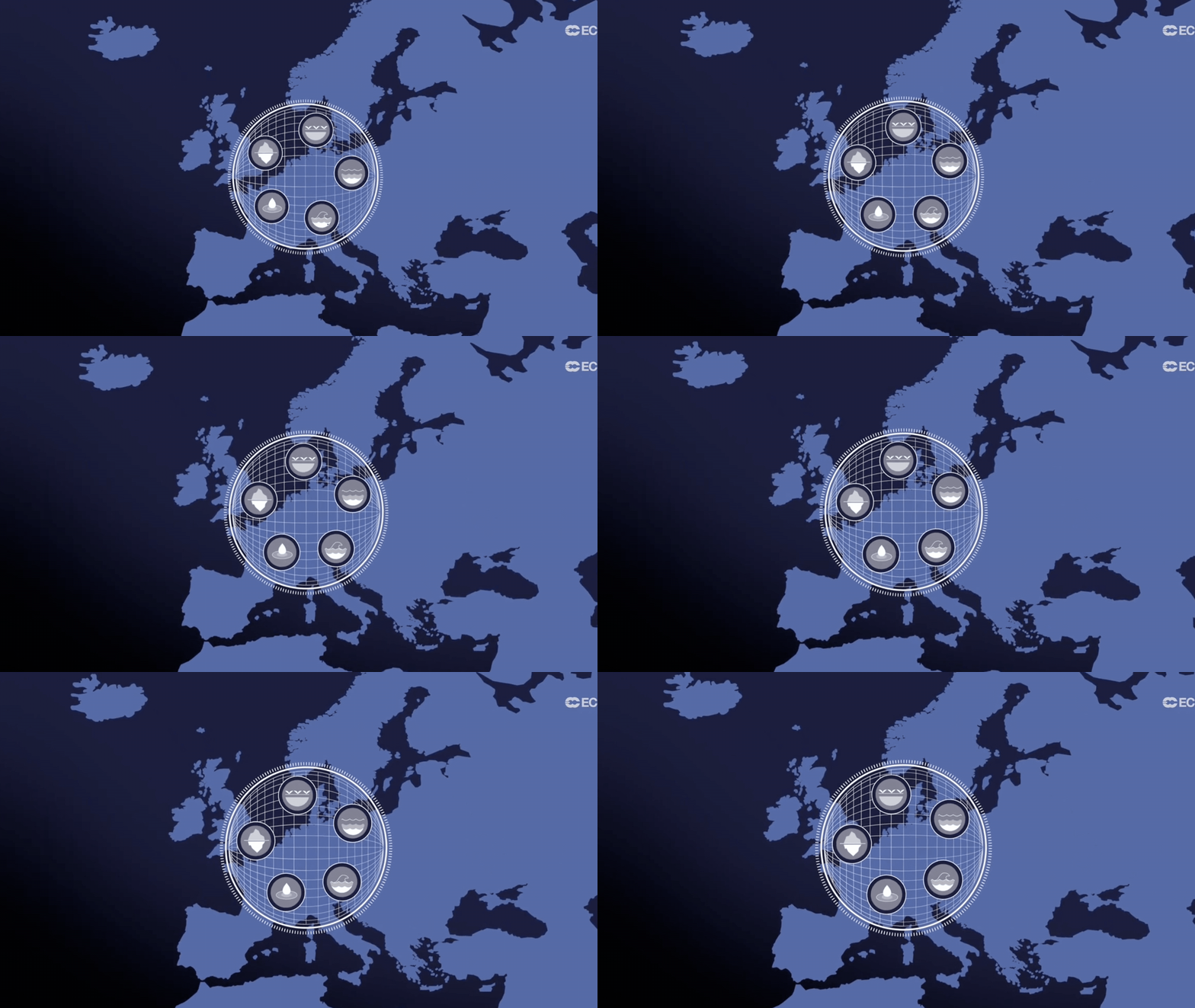
Developing machine learning (ML)-based Earth system model components is central to the AI activities implemented by ECMWF and their partners in the Destination Earth (DestinE) initiative of the European Commission. These early ML-based prototypes are already delivering impressive results, leveraging state-of-the-art European datasets and EuroHPC supercomputers to move towards a fully ML based Earth system model.
This page brings together a series of blog articles by ECMWF scientists, complemented by animated videos, exploring the approaches behind these developments and offering insight into the benefits of AI-based models.

Building a data-driven Earth system model at ECMWF
Illustration of how missing values are handled in Anemoi. The model is allowed to predict snow cover over the oceans, but the regions are masked and filled with missing values in the output.
Our latest blog takes a closer look at how ML models were developed for several Earth system components in the framework of the EU DestinE initiative. Written by ECMWF scientists, the article explains the growing importance of AI-driven Earth system models and how they enhance our ability to understand and predict complex environmental processes.
The blog dives into the several core components, including hydrology, waves, sea ice, ocean and land surface. Together, these components will be coupled with AIFS, ECMWF’s operational AI-based weather forecasting system, forming a next-generation, fully AI-driven Earth system model within DestinE. The blog also explores the challenges ahead, highlights key technological innovations, and outlines the future direction of AI in Earth system modelling.

Land Component
Land surface processes shape everyday weather and climate, influencing water availability, droughts, snow cover, and urban heat. They regulate exchanges of heat, moisture, and energy between land and atmosphere, but are difficult to model due to their complexity. aiLand is a global deep learning model developed at ECMWF to emulate key land surface processes. Trained on data from ECMWF’s advanced physical model, it learns how landscapes respond to changing weather, delivering reliable predictions across diverse climates much faster and with far lower computational cost than traditional physics-based models.
Watch the video on the AI Land Component:

Wave Component

Ocean surface waves, generated mainly by wind acting on the sea, are a dynamic and integral part of the Earth system. Skilful predictions are crucial to mitigate hazardous marine conditions. DestinE’s AI-based wave model emulates ocean wave dynamics, trained on over 40 years of output from ECMWF’s physical wave model. The model learns how waves form, grow, and travel. It delivers reliable predictions while being more computationally efficient than physics-based approaches. It uses atmospheric input from AIFS, and can be coupled with components such as the ocean and sea ice, integrating naturally into broader Earth system simulations. Read the full blog.
Watch the video on wave animation:

Hydrology Component

The “AI for Flood Forecasting” (AIFL) is a global deep learning model developed at ECMWF to estimate daily streamflow at the catchment scale, including in ungauged basins. It is built to provide rapid, reliable predictions using publicly available data. Trained on thousands of river basins across the globe, it learns how different landscapes respond to changing weather conditions, enabling predictions across a wide variety of climates and terrains.

Sea Ice Component

As sea ice prediction has become increasingly important, this new ML component learns directly from decades of high-quality reanalysis data to model the evolution of sea ice and surface-ocean conditions. When forced by atmospheric predictions, the ML model can accurately represent the complex sea-ice evolution, capturing both typical seasonal cycles and challenging ice-edge behaviour.

Ocean Component
The Ocean Component models the evolution of the ocean throughout its depth, including its response to atmospheric forcing. It predicts global spatial fields for key physical variables such as temperature, salinity, currents, and sea surface height anomaly, contributing to a more complete representation of the Earth system.
A blog on this component will follow soon.
Hear ECMWF Scientist Rachel Furner explain the ocean component.