Fifth Destination Earth User eXchange
Fifth Destination Earth User eXchange
 |
9 and 10 June 2026, Maison de la Poste, Tour &Taxis, Brussels, Belgium and online |
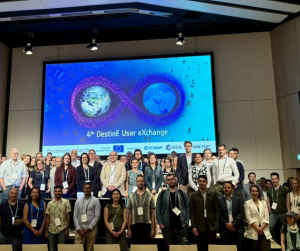
The fifth Destination Earth (DestinE) User eXchange will take place on 9 – 10 June 2026 in Brussels and online. On-site registration is now closed. You can still register to join online.
The User eXchange is the central user engagement event of the DestinE initiative, led by the European Commission (DG CNECT), and brings together the growing community of users and partners involved in the initiative.
Participants will hear the latest updates on the key elements of DestinE – the Digital Twins, Digital Twin Engine, AI models and solutions, Data Lake, DestinE platform and its services – and exchange experiences regarding the use of these novel capabilities.
This hybrid event offers a valuable opportunity to connect with experts from across Europe, find out about the latest advances, and discuss how DestinE supports climate and extreme events resilience and adaptation efforts across Europe. This event is ideal for those currently engaged with DestinE or interested in gaining deeper insights into its potential. Find the Agenda and session descriptions below.
The 5th User eXchange will be hosted by the European Centre for Medium-Range Weather Forecasts (ECMWF), and will be co-organised with the European Space Agency (ESA), and the European Organisation for the Exploitation of Meteorological Satellites (EUMETSAT) and in collaboration with the Royal Meteorological Institute of Belgium (RMI). DestinE is implemented by ECMWF, ESA and EUMETSAT under the leadership of DG CNECT.
Ahead of the User eXchange, a 1.5 day co-design workshop will take place on 8 and 9 June.
The Workshop “Engaging users with DestinE’s energy research” will take place on 9 June, 9:00 – 12:00 CET. You can find a post-event report here.
Agenda
You can find a detailed agenda here.


Session descriptions
Day 1 (9 June):
Opening: Setting the scene
9 June, 13:00 – 13:40, Ticket Window Hall
High-level representatives of the European Commission, the Belgian government, and the European Center for Medium-range Weather Forecasts will set the scene for the 5th Destination Earth User eXchange. They will share their perspectives and expectations for the initiative and reflect on the impact of Destination Earth for European policies and societies.
Introduction by moderator | Simon Pickard
Henna Virkkunen | European Commission (Video message)
Kilian Gross | European Commission DG CNECT
Arnaud Vajda | Belgian Science Policy Office (BELSPO)
Florian Pappenberger | ECMWF
DestinE journey: progress and highlights
9 June, 13:40 – 14:25, Ticket Window Hall
Panelists from the European Commission, ESA, ECMWF, and EUMETSAT will provide a high-level overview update on system developments, presented at a level of general interest to all DestinE users and stakeholders. The session will provide a concise look at current progress and future expectations for Phase 3 of DestinE (2026-2028) across the Climate and Extremes Digital Twins, the Digital Twin Engine, the AI Earth system model and AI based solutions, the Data Lake and the DestinE Platform, providing complementary perspectives on how each component is evolving and contributing to the overall DestinE system.
Charalampos Tsitlakidis, European Commission DG CNECT
Irina Sandu, ECMWF
Lothar Wolf, EUMETSAT
Kathrin Hintze, ESA
Panel discussion | Moderator Simon Pickard
Block 1: DestinE foundations – the digital twins and the data
DestinE for weather extremes and climate adaptation: demonstrations and discussion
9 June, 14:25 – 16:10, Ticket Window Hall
This session will present the Climate and Extremes Digital Twins from both producer and user perspectives. Producers will highlight recent advances in simulation production, quality assurance, and the evolution of Digital Twin capabilities. In particular, they will demonstrate how storylines and what-if simulations can support preparedness and resilience to climate and extreme events across scales, from local to global. Users will share their experience with DestinE, describing how Digital Twin technologies have created new opportunities for their application while also outlining key challenges encountered. The session will conclude with a panel discussion on combining these capabilities and addressing uncertainty quantification to support informed decision-making, highlighting success stories and future perspectives.
The On-demand Extremes Digital Twin
Marianne Thyrring, Danish Meteorological Institute – DMI
The Climate Digital Twin
Jenni Kontkanen, CSC – IT Center for Science
Thomas Jung, Alfred-Wegener Institute – AWI
Q&A
DestinE for multi-scale compound flood risk assessments and adaptation
Kun Yan, Deltares
Insights on past and future heat events from DestinE
Dirk Lauwaet, VITO
Panel discussion and Q&A | All speakers
Accessing DestinE’s capabilities - showcase
9 June, 16:40 – 17:25, Ticket Window Hall
A session showcasing how users can access and work with DestinE data and services. The focus will be on how the available data portfolio can be accessed and connected with decision-support tools used by public authorities and agencies, including through the DestinE Platform, the Data Lake (DEDL), and services such as Polytope. Short live demonstrations may illustrate how these components enable more informed and coordinated policy action.
Introduction: From climate DT to GIS-like access and integration
Nils Wedi, ECMWF
Polytope / Access Climate DT data
Adam Warde, ECMWF
Prismera: Interactive Exploration of Climate DT Storylines
Claire Billant, Gael | Fernando Iglesias-Suarez, Predictia
Access via HDA, specific access
Danaële Puechmaille, EUMETSAT
Discussion and outcome of Co-Design Workshop
Danaële Puechmaille, EUMETSAT | Nils Wedi, ECMWF | Franka Kunz, ESA | Claire Billant, Gael
Fireside chat: European perspectives on DestinE
9 June, 17:25 – 18:05, Ticket Window Hall
Representatives from key European Commission Directorates-General will share policy perspectives on how Destination Earth supports Europe’s climate resilience, energy transition, and environmental objectives.
Moderator: Simon Pickard
Panelists:
Grazyna Piesiewicz, European Commission DG CNECT
Elina Bardram, European Commission DG CLIMA
Michela Matuella, European Commission, DG ECHO
Christoph Kautz, European Commission DG DEFIS
Ariane Labat, European Commission DG INTPA
Keynote speech
9 June, 18:05 – 18:25, Ticket Window Hall
Perspective on the value and innovation of DestinE and how it is expected to enhance weather and climate resilience and preparedness.
Maarten van Aalst, Royal Netherlands Meteorological Institute – KNMI
Posters and demos & cocktail reception
9 June, 18:25 – 19:30, Courtyard and Foyer
Interactive showcase of posters and demos highlighting technical developments, applied use cases, and innovative solutions within the DestinE ecosystem. Dedicated demo stations from each of the three entrusted entities, ECMWF, ESA, and EUMETSAT (with participation from contractors as required) will offer participants the opportunity to engage directly with experts.
This showcase takes place in parallel to the cocktail reception.
Day 2 (10 June):
Block 2: DestinE breakthrough – artificial intelligence
AI Earth System Model (ESM) and interactivity within DestinE
10 June, 9:00 – 10:15, Ticket Window Hall
This session will explore the development of an AI Earth System Model (AI ESM) and the application of artificial intelligence across key impact sectors, leveraging AI-ready digital twin data alongside other European datasets. It will also highlight advancements in interactivity within DestinE, including through developments on the DestinE Platform. Presentations will demonstrate how AI is being harnessed to construct machine learning models for Earth system components and to develop innovative tools such as forecast-in-a-box. Furthermore, the session will examine how DestinE’s AI-ready datasets contribute to the EU’s AI factories, stimulating the creation of a new generation of AI-driven applications.
Setting the Stage: AI Earth system modelling
Sara Hahner, ECMWF
DestinE Climate Emulator: Fast, stable, scenario-aware
Fernando Iglesias-Suarez, Predictia
The future of DEA: Conversational interface for Earth Intelligence
Arturo Montieri, Alia Space
Trust, ethics and quality for AI on the DestinE platform
Florence Luvisutto, EKITIA
Panel discussion and Q&A
Luca Girardo, ESA
AI tooling in DestinE
10 June, 10:45 – 12:00, Ticket Window Hall
This session focuses on AI solutions and enabling capabilities within the DestinE environment, highlighting how AI-related work is supported in practice. It covers the tools, services, and infrastructures that allow users and developers to access data, experiment with AI methods, operationalise workflows, and integrate AI components within DestinE.
Session introduction
Tiago Quintino, ECMWF | Miruna Stoicescu, EUMETSAT
AI tooling provided by ESA
Najla Said, Serco | Benoît Pironnet, GAEL Systems |Jens Henrik Göbbert, Forschungszentrum Jülich
Anemoi | Harrison Cook, ECMWF
Forecast-in-a-Box | Tiago Quintino, ECMWF
AI capabilities and tooling provided by the DestinE Data Lake | Miruna Stoicescu, EUMETSAT
AI4Clouds: Enhancing short-term cloud fields in DestinE for the solar-energy sector
Fernando Iglesias Suarez, Predictia
Q&A session | All speakers
- Miruna Stoicescu, EUMETSAT
Block 3: DestinE in action – applications and outlook
Connecting DestinE with sectoral applications - from demonstrations to impacts
10 June, 13:00 – 14:00, Ticket Window Hall
This session explores how DestinE services can support solutions in different impact-sectors. In short interventions, speakers will illustrate how DestinE outputs are already informing solutions in their domains such as agriculture, health, and finance. The discussion will then look ahead to what additional capabilities, data connections, and partnerships are needed in the next phase to further connect the Digital Twins with sectoral models and services, strengthening DestinE’s contribution to impact assessment and decision-making across sectors.
Agricultural modeling supporting EU policies
How DestinE can contribute
Sara dal Gesso, AMIGO
Managing heat impact on health in a changing climate with DestinE
Ana Oliveira, +Atlantic
How the DestinE Co-Design methodology can be applied in practice
Patrick Knöfel, Federal Agency for Cartography and Geodesy – BKG
Managing air quality issues using DestinE simulations
Karine Leger, Air Parif
Panel discussion | All speakers
Harnessing DestinE for EU policy and global action
10 June, 13:00 – 14:00, Maritime Room
This session will provide a platform for European Commission Directorates-General, including DG INTPA, DG CLIMA, DG ENER and others, to outline how Destination Earth can be leveraged across EU and international cooperation programmes. Discussions will highlight opportunities to use DestinE to support climate adaptation, energy transition, resilience and preparedness initiatives, including through global partnerships such as ArcX implemented under the EU’s Global Gateway strategy.
Welcome
Cecilia Donati, European Commission DG INTPA | Stijn Vermoote, ECMWF
Global gateway – digital agenda
Miguel Exposito, EC DG INTPA
Climate adaptation, resilience and international climate cooperation
Representative of European Commission DG CLIMA (TBC)
Humanitarian Aid and digital transformation, ERCC perspective
Olimpia Imperiali, EC DG ECHO
Panel dialogue:
How DestinE can support policy priorities on climate adaptation, energy transition, resilience and preparedness in the EU and at a global level
Moderator: Cecilia Donati, European Commission DG INTPA
Stijn Vermoote, ECMWF
Panelists:
- Grazyna Piesiewicz, European Commission DG CNECT
- Miguel Exposito (DG INTPA)
- Eleonore Buffet Heuser (DG CLIMA)
- Olimpia Imperiali (DG ECHO)
Q&A and wrap-Up
Cecilia Donati, European Commission DG INTPA | Stijn Vermoote, ECMWF
Using DestinE for energy applications
10 June, 14:05 – 15:05, Ticket Window Hall
The session will discuss key achievements from recent developments in energy domain under DestinE’s, in the context of present and future challenges that the European energy sector is facing. Through a panel discussion bringing together experts from policy and industry, and with active participation from the audience, the session will highlight available capabilities while fostering a dialogue on the evolving needs and opportunities for of the European energy community.
Opening remarks & introduction
Francesc Roura, Barcelona Supercomputing Center (BSC),
Ira Shefer, Renewables Grid Initiative (RGI)
Elevator pitches
- Bruno Schyska, German Aerospace Center (DLR)
- Francesc Roura, Barcelona Supercomputing Center (BSC)
- Irene Schicker, GeoSphere Austria
- Piet Termonia, Royal Meteorological Institute of Belgium (RMI)
Panel discussion
Moderators: Francesc Roura, Barcelona Supercomputing Center (BSC) Ira Shefer, Renewables Grid Initiative (RGI)
Panelists:
- Laurent Dubus, RTE / ENTSO-E
- Andreas Zucker, European Commission DG ENER
- Gabriela Basarab, CurrENT Europe
- Miguel Córdoba, Ocean Winds
Q&A
Moderators: Francesc Roura, Barcelona Supercomputing Center (BSC)
Ira Shefer, Renewables Grid Initiative (RGI)
Concluding remarks
Francesc Roura, Barcelona Supercomputing Center (BSC)
Ira Shefer, Renewables Grid Initiative (RGI)
Exploring the water cycle with DestinE
10 June, 14:05 – 15:05, Maritime Room
A session exploring how DestinE can advance understanding and management of the water cycle beyond disaster risk applications. Discussions with users will explore how DestinE digital twins and AI-driven approaches support environmental monitoring, water resources management, and hydrological forecasting. The conversation will engage a wide array of communities to collect user needs, identify future water-related challenges and explore opportunities for developing new tools, services and applications building on DestinE capabilities to support environmental and water-related decision-making.
Introduction of the moderators, scene setting & breakout instructions
Willem Maetens, Flemish Environmental Agency
Session instructions – ARUP
Slido – “Who is in the room?”
Moderators:
- Willem Maetens (Flemish Environmental Agency)
- Eloisa Vargiu (Cetaqua Barcelona)
- Catherine Buckley (ARUP)
- Ros Vose (ARUP)
- Ljiljana Zlatanovic (ARUP)
- Mads Baden Jensen (ARUP)
- Michael Jungbluth (Federal Institute of Hydrology – BfG)
- Albrecht Weerts (Deltares)
- Kateřina Varenne (DG Environment, European Commission)
Presentation of breakout group discussions | All moderators
DestinE for disaster risk management
10 June, 15:35 – 16:35, Ticket Window Hall
A session exploring how DestinE can enhance disaster risk management (DRM) by supporting preparedness, response and recovery across different hazards. Presentations will feature examples from ongoing DestinE projects and on-boarding activities, including past, present and future use cases, collaborations with operational systems, and will highlight how AI and machine learning demonstrators can improve early warning, preparedness planning and decision-support capabilities. The discussion will bring together DRM authorities, practitioners or researchers to identify opportunities for needs assessment, collaboration and co-development of future capabilities.
Short introduction to session objectives, Digital Twin use cases on precipitation & floods
- Piet Termonia, Royal Meteorological Institute of Belgium (RMI)
- Steven Caluwaerts, Royal Meteorological Institute of Belgium (RMI) and Ghent University
- Online: Ursula McKnight, Swedish Meteorological and Hydrological Institute (SMHI)
Short introduction from the European Commission
Q&A
Moderators: Juha-Pekka Jäpölä, European Commission DG ECHO and speakers from previous session
How urban areas can benefit from DestinE
10 June, 15:35 – 16:35, Maritime Room
A session exploring how DestinE can support urban decision-making and public services, from day-to-day management to long-term planning. Presentations will showcase examples of how digital twins and AI applications can be used to assess heat exposure, air quality and combined urban risks, and to inform adaptation and sustainability strategies. The discussion will engage representatives from research institutes, local authorities or service providers to identify opportunities for collaboration and co-development of urban applications, surfacing concrete user requirements, trust/quality expectations, and integration needs.
Opening & framing | Madleen Bultez, Mews Partners
Citynexus | Alessandra Feliciotti, MindEarth
Urban heat pilot | Nele Veldeman, VITO
Panel discussion, Q&A
Moderator: Federico Fierli, European Commission
- Laura Hetel, European Commission DG RTD
- Konstantinos Zervas, New Metropolitan Attica
- Cristina Pavelescu, ADIZMB – Bucharest
- Natalie Theeuwes, KNMI
Closing Remarks
10 June, 16:40 – 17:00, Ticket Window Hall
The European Commission and the three entities implementing DestinE will conclude the Forum, reflecting on outcomes and the way ahead. and a live reveal of the event illustration capturing the main discussions, achievements, and ideas from across the two days.
- Charalampos Tsitlakidis, European Commission, DG CNECT
- Kathrin Hintze, ESA
- Lothar Wolf, EUMETSAT
- Piet Termonia, Royal Meteorological Institute of Belgium (RMI)
- Irina Sandu, ECMWF
Training sessions:
Please note that each training session will be offered twice.
Training: From Data to Insights - working with DestinE Edge services
10 June, 13:00 – 14:00, Gaming Room / 14:05 – 15:05, Winter Garden
This training provides a practical introduction to Edge services and the HDA (Harmonised Data Access) service. The training session covers the end-to-end journey from the navigating the platform to accessing and using Edge computing services. The session will cover how HDA provides unified data discovery, access, and retrieval mechanisms to support a wide variety of applications. Participants will obtain knowledge on available services that enable the development of new DestinE applications and services at the edge of data.By the end of the training, attendees will:
- Understand the core principles and benefits of Edge Services
- Learn how HDA provides harmonised data access across diverse sources
- See how Edge and HDA services complement each other
This training is suitable for all DestinE users, including non-experts.
Lead trainer: Danaele Puechmaille
Training: DEFAIR (DestinE framework for AI Ready data) Essentials - Principles, Tools, and Best Practices
10 June, 13:00 – 14:00, Coffee Lounge / 15:35 – 16:35, Gaming Room
This training introduces DEFAIR, the Destination Earth Framework for Preparing AI Ready Data. Participants will learn how to process Earth observation datasets, such as those available through the Destination Earth Data Lake (DEDL) with a focus on data from EUMETSAT, into AI-ready data. The session will cover key preprocessing steps including reading, reprojection, spatial filtering and variable selection, using DEFAIR’s modular Python framework with dedicated readers and transformation components. Participants will explore how to apply transformation chains and generate structured data cubes that can be directly used for AI/ML model development. The training will also demonstrate how to export processed outputs in formats such as NetCDF and Zarr. Designed for researchers and developers, the session combines practical examples with hands on demonstrations using notebook environments and S3 based data access within DEDL. By the end, users will understand how to integrate DEFAIR into their own workflows and streamline the preparation of Earth observation data for AI applications.
Lead trainer: Sina Montazeri, EUMETSAT and Peter Boxall, Oxidian
Training: Accessing and exploiting DestinE Climate DT data in DestinE Platform
10 June, 14:05 – 15:05, Library / 15:35 – 16:35, Library
This training will present the different ways to access ECMWF’s Climate DT data through the DestinE Platform’s services. It will first introduce Insula Code service, allowing users to interface with different data access services of the platform via Jupyter notebooks (Polytope, HDA, DestinE Streamer, Earth Data Hub, etc.). In a second part, in a hands-on exercise, participants will be able to develop and test their own code for accessing Climate DT data in Zarr format through the Earth Data Hub service.
Lead trainer: Barbara Scarda, Serco
Training: Working with Digital Twin Earth system data
10 June, 14:05 – 15:05, Coffee Lounge / 15:35 – 16:35, Coffee Lounge
Unlock the potential of Destination Earth’s high-resolution data using Earthkit, ECMWF’s open-source Python toolkit. This hands-on course guides you through the complete data lifecycle—from accessing massive Digital Twin datasets to performing complex processing and creating publication-ready visualisations. You will learn how Earthkit abstracts data complexity, enabling efficient handling of high-resolution outputs, climate aggregations, and interactive mapping within a unified Python environment. Whether you are analysing extreme weather events or computing climatologies, this session provides the essential workflows to integrate DestinE data into your scientific research or user application development.
Lead trainer: James Varndell, ECMWF
Training: Co-Designing services for the DestinE Platform
10 June, 13:00 – 14:00, Winter Garden / 15:35 – 16:35, Winter Garden
Earth Observation service developers often face a fundamental challenge: bridging the “grand distance” between data capabilities and the concrete needs of users who may not be aware of what DestinE data could bring to their activities. This 1-hour session introduces the co-design methodology developed by Mines Paris – PSL for Destination Earth, now augmented with a generative AI web application. The toolkit guides service developers through a structured 4-phase process: approaching users, co-design diagnosis, workshop sessions, and outcomes. Come discover how to move from latent user demand to resilient, scalable services and how generative AI can be used to support this journey.
Lead trainers: Nicolas FICHAUX, Alexandre Azoulay, Malik Terfous, Skander Ben Yahia (MINES Paris PSL / ARMINES), Madleen Bultez, Clara Tawil (MEWS Partners), Franka Kunz (ESA)
Training: Interactivity and interoperability with Digital Twins
10 June, 13:00 – 14:00, Library / 14:05 – 15:05, Gaming Room
Discover the machinery powering interaction with Destination Earth. This course explores the advanced interfaces designed to make petabyte-scale Digital Twin data accessible and actionable, targeting users more familiar with GIS data types. We introduce Polytope to bring complex weather and climate data in reach of such users, with efficient data slicing and fusion. We will also introduce Aviso, an event-driven notification system on data availability. You will learn to move beyond bulk downloads by requesting specific features or datacubes via standard OGC APIs, handling web-friendly formats like CoverageJSON, H3, and polygon selections of data combined with automating processing chains. This session is useful for users building applications with weather and climate information, including automated pipelines, or web services on top of DestinE infrastructure.
Lead trainer: Adam Warde, ECMWF
Learn more about the last User eXchanges: